
St. Joseph City Directory Holdings
The St. Joseph Public Library city-directory holdings are the central local collection for a dated name-and-address search. The listed print run begins with 1859–60 and ends with 2018. It is a long, uneven run rather than one continuous publication. The Reference Department keeps the material as physical volumes and microfilm, so a searcher can inspect the title page, index, abbreviations, and neighboring entries instead of relying on an unverified transcription. The library describes the collection as a reference resource, not a fully searchable online resident list.
| St. Joseph collection | Years held | Where held | How to use it |
|---|---|---|---|
| Printed directories | 1859–60 through 2018, with listed gaps | St. Joseph Public Library Reference Department | Physical reference collection |
| Directory microfilm | 1859–61 through 1960, with overlaps and gaps | St. Joseph Public Library | Local microfilm access |
| 1869 directory scan | 1869 | Internet Archive and Wikimedia Commons | Image and OCR should be compared |
| Notices, phone books, yearbooks, local history | Varies by title | Library Reference Department | Staff research request or local use |
The published holdings list skips 1893; 1914; 1919–20; 1922–23; 1925; 1927; 1929; 1931; 1934; 1936; 1943–45; 1948; 1950; 1952; 1954; 1966; 1994; and 2008. A date gap is a reason to test adjacent volumes, newspaper notices, and other records. It is not proof that no household was present in St. Joseph.
St. Joseph Directory Title Pages
Publisher names help identify an edition, but they should be used as a title-page check rather than as a shortcut for an entire run. Historic context points to H. Fotheringham in 1859–61, Frank Swick or Zwick in 1867–68, George & Craig in 1881–82, Hoye during much of 1883–96, Combe from 1897 into the early twentieth century, and Polk in many later years. Publisher spellings vary in the surviving material. Record the title, publisher, year, and page from the volume actually consulted.
A historical volume may carry an alphabetical resident and business section, classified material, and institutional listings in the same book. Missouri Digital Heritage notes that nineteenth-century volumes can carry names, addresses, occupations, business details, forwarding information, death notes, and biographical details. Those fields are clues tied to the publication date. They do not establish a present address or a relationship on their own.
- 1859–60: The library's listed St. Joseph run begins.
- 1867–68: The Swick or Zwick resident and business era provides a distinct title-page checkpoint.
- 1883–96: Hoye editions form a substantial late-nineteenth-century sequence, with the individual volume controlling citation.
- 1897 through early twentieth century: Combe and later Combe-Polk editions bridge into the many Polk years.
- 2010–18: The final listed run ends in 2018.
Note: A title page is the best way to resolve a publisher name when a catalog entry and historical account use different spellings.
St. Joseph Directory Library Routes
The St. Joseph Public Library Reference Department connects the directory shelf with microfilm, genealogy sources, cemetery research, newspapers, yearbooks, and local-history material. A local visit makes it possible to inspect both the alphabetical entry and the street section in the same volume. For remote research, the library advises supplying approximate dates, spelling variants, places, and relationships so staff can narrow the right source family.
The library's holdings page shows why the collection needs date-by-date checking rather than a single broad name search.
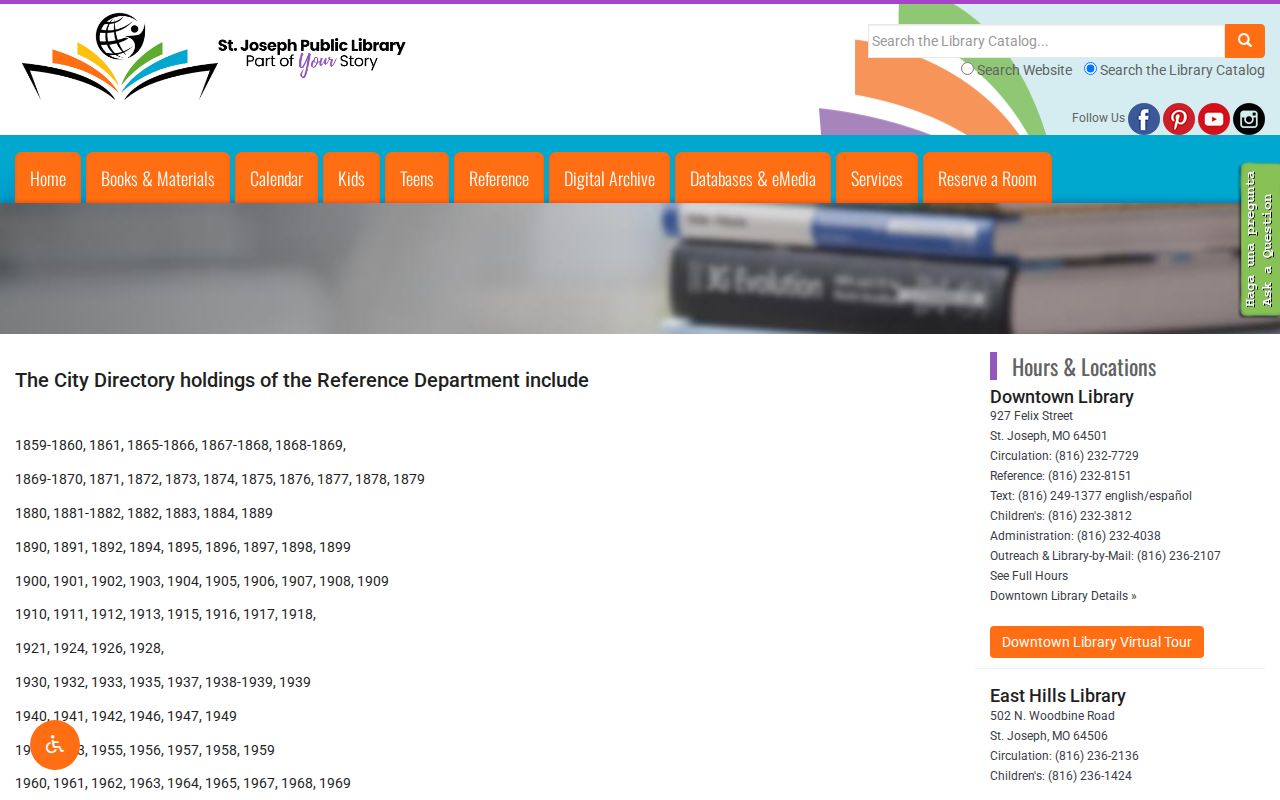
Physical and microfilm access preserves details that a short catalog description cannot show, including the exact year gaps and the layout of a chosen volume.
The library research-request service offers out-of-town work at $10 for 30 minutes, capped at two hours and $40. Staff can search old directories, phone books, yearbooks, local history, and News-Press/Gazette death, marriage, birth, and divorce notices. The requested date window matters. Ask for both a resident/business entry and a street-section check when an address is known.
The request form identifies the local-history and directory channels available through the Reference Department.
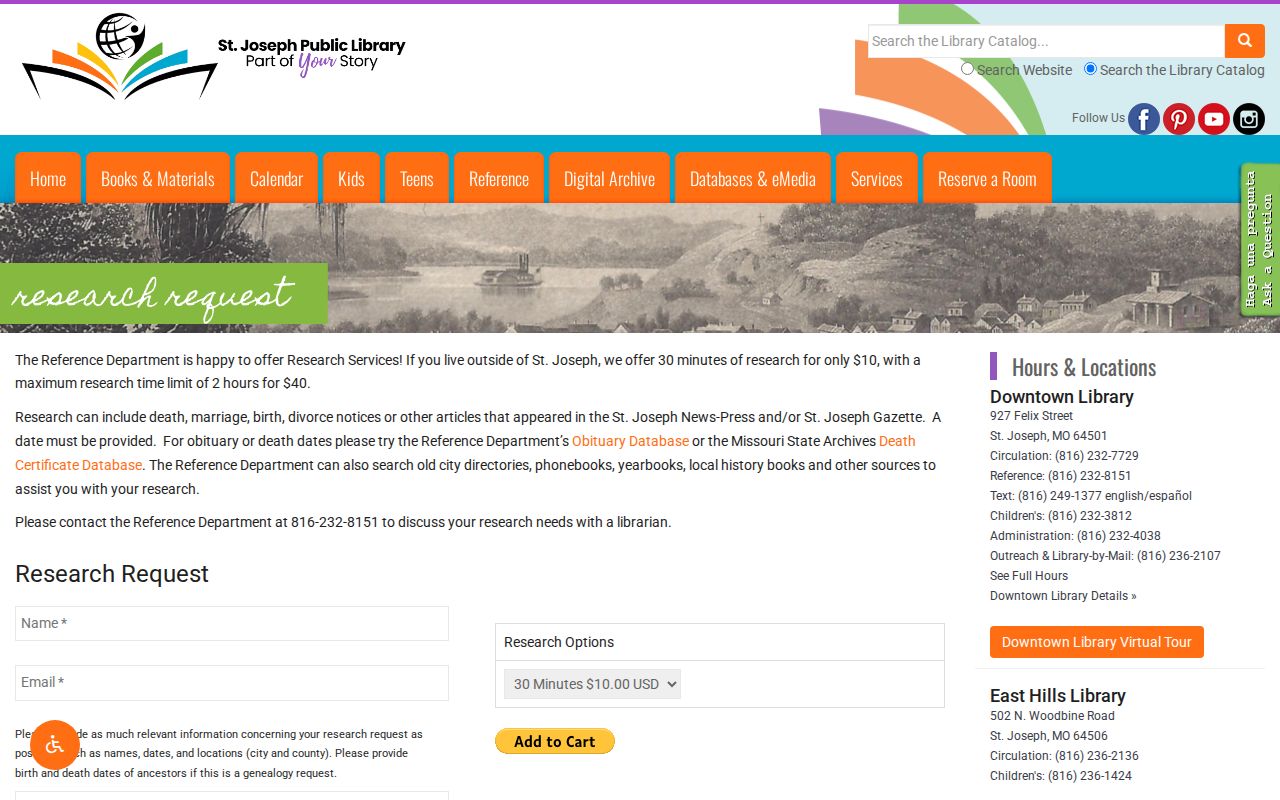
That route is useful for a focused family-history question, but it does not promise that every directory year or every household has an index entry.
Reading a St. Joseph City Directory Entry
Read an entry as a compact record, not as a complete biography. The 1869 scanned volume demonstrates the pattern: a name is paired with an occupation or business description, a residence direction, a street, cross streets, and a shorthand residence notation. Some later editions organize related information differently, so the abbreviation key and the page heading should be photographed or transcribed with the entry. A household can be missed when initials, a spouse's name, or a variant spelling was used.
| Name | The displayed surname, initials, or given name, copied as printed. |
|---|---|
| Occupation or business | A useful distinction between people with the same name, when present. |
| Residence description | Street, direction, house number when supplied, or cross-street wording. |
| Abbreviation | Terms such as a residence shorthand should be read through that volume's key. |
| Section and page | The alphabetical or street section, plus page, so the finding can be repeated. |
- Criss-cross section
- A street-ordered section used to approach a location rather than a surname. The locally documented route is to check the street material in the volume or ask Reference staff about later telephone or reverse material.
- Householder index
- An index arranged around households or addressable heads of household. Its scope depends on the particular volume and should not be assumed from another year.
- Abbreviation key
- The publisher's explanation of shortened terms. It belongs to the edition being read because period wording and layout can change.
St. Joseph City Directory Evidence in 1869
The 1869 Saint Joseph directory scan supplies a concrete reading test. Its alphabetical material includes entries that give a surname and initial, an occupation, a residence direction, street and cross-street language, and the phrase “res same.” The sample confirms what that edition can show. It does not verify an exact modern street number, a current identity, or a family relationship.
OCR in an older scan can misread a street name. For example, the research inspection found an OCR variation for Sylvanie. Inspect the page image before silently correcting a word or joining two similar names. The difference between a north-side description and a southwest-corner description can be the point that separates two people. This is especially important when directories describe a street by cross streets instead of a numbered address.
Tracing St. Joseph City Directory Households
Use a St. Joseph city directory as a dated checkpoint in a household trail. Start with the closest available year, then move forward and backward one held edition at a time. Record the exact wording, page, address description, occupation, and source type. Pairing directories with census years helps bridge a decade, but it does not turn a directory listing into a census substitute. A disappearance may reflect a move, death, changed spelling, omission, or a missing publication year.
- Choose the nearest held directory year and search surname variants in the alphabetical section.
- Copy the entry exactly, including its page, abbreviations, occupation, and address language.
- Check the street section or ask the Reference Department for the address-side material available for that period.
- Compare the next held year in each direction and align the sequence with the relevant census decade.
- Test a departure through the library obituary database, newspaper notices, and the local-history index rather than treating one absence as a conclusion.
The St. Joseph Public Library obituary database and staff request route are the local follow-up channels. NewsBank covers the St. Joseph News-Press from 1999 forward, while the library describes separate newspaper and obituary resources for earlier work. Date coverage varies by title and database, so a no-result needs the same caution as a directory gap.
St. Joseph Directory Maps and Archives
Directory work gains geographic context from the library map collection. It lists an interactive 1877 Buchanan County atlas and St. Joseph Sanborn resources for 1883, 1888, 1897, 1904, 1911, 1935, and 1938. The 1911 Library of Congress item is a 72-sheet, 73-image Volume 2 sequence, republished in 1955. A map can test a street name, building footprint, cross street, alley, or adjacent property in the directory year. It cannot identify a resident by itself.
The Buchanan County Archives finding aid supplies another era bridge: county-court material from 1839–1901, probate series, wills and naturalization indexes, and early tax lists. The St. Joseph Museums research route and the State Historical Society of Missouri Buchanan collections add institutional sources such as WPA survey and Stockyards material. These collections add context or a separate record type; neither is a complete resident index.
St. Joseph Directory Index Limits
The Local History Index is an electronic work in progress. Its PDF points from a bibliographic number and page to a bibliography and the Reference Department. The library states that its paper index is more complete than the electronic version. A missed online name is therefore a prompt to check the paper index or request a narrow staff search, not a reliable negative result.
For an 1890s name, pair the nearest listed directory volume with the 1890–92 or 1894–99 runs, the 1897 Sanborn resource, and the Buchanan finding aid. For a 1910s name, compare the 1911 Sanborn material, the listed publication gaps, census or tax series, and newspaper indexes. Each source records a different fact at a different date. That small evidence bundle is stronger than treating a single printed line as the whole household story.
Keep source types separate. A directory establishes that an entry appeared in a dated publication; a Sanborn sheet describes map-era geography; an obituary or county record has its own scope. When the historical question shifts to a current address-keyed record, the St. Joseph street directory gives the modern street-record route without treating the old volume as a present-day list.