
St. Joseph Previous Residents by Era
To find previous residents, match the source to the period instead of expecting a single address list. Buchanan County’s modern property roll is a current starting point, while deeds trace legal transfers and the library’s directories offer dated household leads. Early county books, maps, census and tax material, and library indexes take over when a modern portal reaches its limit. Each row below identifies what a source can show, not a guarantee that it records every past occupant.
| Source | Years it covers | Where held | What it can show |
|---|---|---|---|
| Property Tax Inquiry | Current data; historical retention not confirmed | Buchanan County online portal | Parcel, owner label, situs, and current assessment context |
| Recorder modern index | Current index; online cutoff not verified | iCounty and Recorder | Recorded instruments and title leads |
| Historical grantor/grantee books | Nineteenth-century material; inspect target book | County-linked historical route | Earlier owner-name transaction leads |
| St. Joseph city directories | 1859–2018, with listed gaps | St. Joseph Public Library | Dated resident, business, and street-index entries |
| Sanborn and 1877 atlas | 1877; 1883, 1888, 1897, 1904, 1911, 1935, 1938 | Library maps and selected Library of Congress material | Street, block, building, and use context |
| County finding aid and census/tax | Selected county court, probate, tax, and census series | Missouri State Archives | Record-era corroboration beyond a directory year |
Start with today’s normalized address and parcel, then choose the nearest older source. A missing year should be logged as a gap, not turned into a conclusion that nobody was there. In particular, the modern recorder’s online cutoff and a separate official reverse-directory collection were not verified in the research.
St. Joseph Address Archaeology
Address history rests on four distinct kinds of evidence: a current parcel, a dated Sanborn or atlas sheet, a directory street index, and a recorded instrument. The Property Tax Inquiry accepts parcel number, owner name, house number, street name, and city for real estate. Save the returned spelling and date, then compare the situs address to any mailing address shown. The situs identifies the mapped parcel. A mailing address can be only a tax-bill destination.
When an old street number does not line up with a current one, do not invent a citywide renumbering event. No verified official St. Joseph renumbering or street-renaming project and year was found. Compare the same block in the 1877 atlas, the available Sanborn years, directory street indexes, legal descriptions, and historic plat material. That preserves a useful uncertainty while still giving an older address a fair test.
Note: A parcel’s owner label, a directory entry, and a map placement are separate evidence types with separate dates.
St. Joseph Previous Residents Deed Chain
The deed trail begins with the property, not a broad person-name search. Use the parcel number and legal description from the assessment and GIS routes, then move into the Recorder’s instruments. The Buchanan County Recorder of Deeds links public-record search, iCounty access, and historical grantor/grantee books. iCounty uses registered and paid access tiers, and the exact public online index cutoff was not visible without login. Confirm whether an instrument belongs in the modern system, historical book scan, or an in-person volume.
- Record the current parcel number, situs, and legal description from the property and GIS results.
- Find the current title holder as a grantee in the recorder index, then record document type, date, book and page or instrument number, and legal description.
- Use the seller from that deed as the next grantee search, keeping spelling variants beside the result.
- Repeat the transfer sequence backward until the target year, historical-book boundary, or a documented gap.
- Compare the legal description with subdivision, lot, tract, block, and map evidence before linking an older record to the modern street address.
A document delivered to the Recorder after the listed 4 p.m. cutoff is recorded the next business day beginning at 8 a.m. That timing can matter when a deed chain is ordered closely, but it does not determine who occupied the address.
- Grantor and grantee
- The grantor transfers an interest in a recorded instrument. The grantee receives that interest.
- Chain of title
- The ordered sequence of recorded transfers associated with a parcel or legal description.
- Legal description
- The lot, block, tract, subdivision, or other formal land description in a deed. It usually survives address changes better than a street number.
St. Joseph Previous Residents in Directories
Directories supply a publication-date snapshot, not a complete address census. The St. Joseph Public Library holdings run from 1859 through 2018 but list many breaks, including 1914 and several later years. Use the volume closest to the event, inspect its street index as well as the alphabetical resident or business section, and record the publisher and page. No separately titled official digitized criss-cross run was located, so a street index is the documented local address route.
- Choose the closest available directory year and note any gap before or after it.
- Search the street section for the address, then read the matching resident or business entry in the alphabetical section.
- Pair the dated directory lead with the relevant Missouri census or tax series, logging county, series, year, and search terms.
- Test a name through obituary, newspaper, probate, naturalization, or local-history material only when the date and address evidence support the same person.
The library’s paper local-history index is more complete than its electronic work in progress. When a remote search needs help, the Reference Department’s paid request service can check old directories, notices, newspapers, yearbooks, and local history with a narrow date and location window. The collections themselves have more detail on the St. Joseph Directory Book.
Maps for St. Joseph Previous Residents
The St. Joseph Public Library maps collection lists the 1877 interactive Buchanan County atlas and Sanborn material from 1883, 1888, 1897, 1904, 1911, 1935, and 1938. Maps can test a street name, block layout, building footprint, alley, or adjacent structure in a particular era. They do not identify every person who lived there.
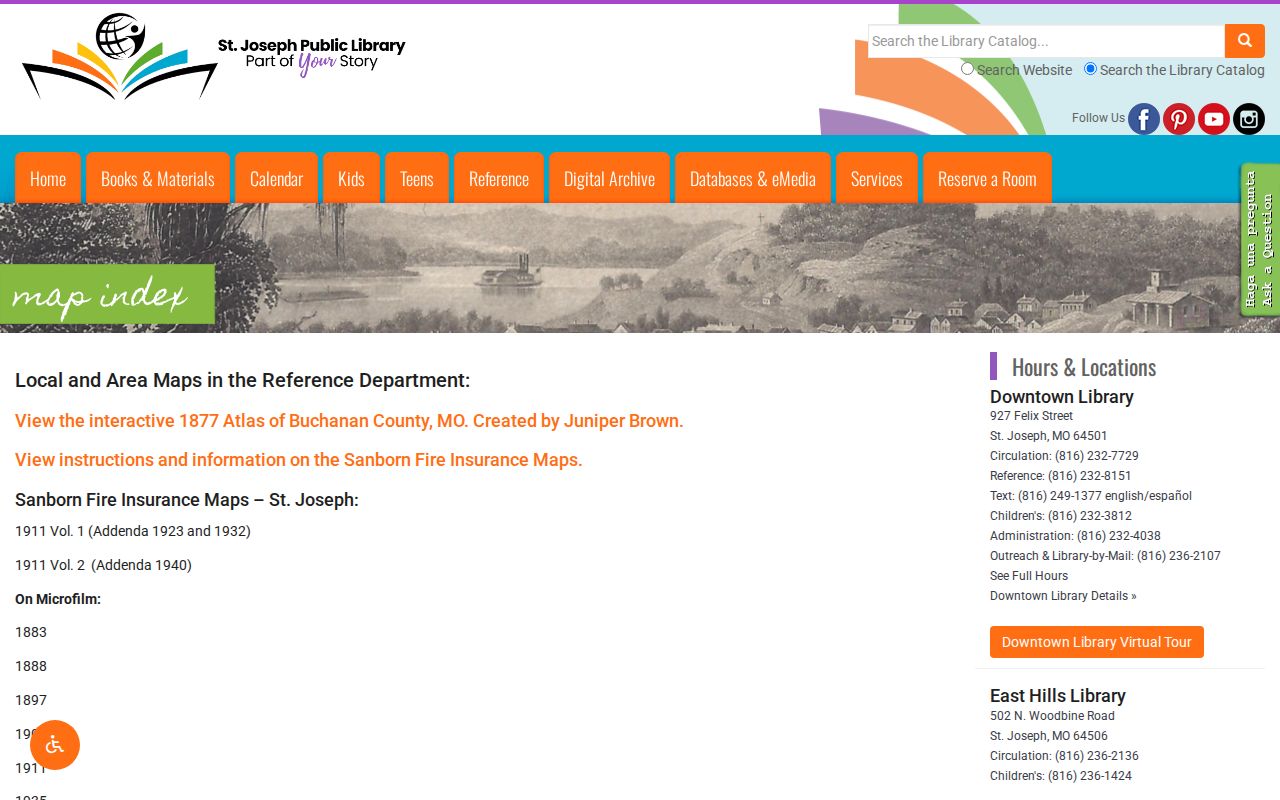
Use the map year as a dated physical-context check beside the deed and directory citations. A Sanborn sheet may show a changed structure while a directory shows a name and a deed shows title. Keeping those findings separate is the useful part of St. Joseph address archaeology.
St. Joseph Archives for Past Residents
The Buchanan County Archives finding aid supplies another bridge when the directory and deed trail grows thin. It lists county court records from 1839–1901, probate volumes beginning in 1839, a wills index from 1842–1921, naturalization indexes, and tax lists for 1840, 1841, 1842, and 1846. “Indexed” can mean a reel or manuscript index rather than an online name search, so plan for an archive request or research-room route.
Obituaries, newspaper notices, probate, and cemetery references can help close a dated household trail, but none should be stretched into proof of an address at a different time. The State Archives census/tax database lets researchers narrow by name, county, series, notes, year, and other fields. Keep the repository, record type, and retrieval date with every result.
For an 1880s St. Joseph trail, compare an available directory with the 1877 atlas, the 1883 or 1888 Sanborn material, pre-1910 birth or death abstracts, and the finding aid’s probate or naturalization indexes. For a 1910s question, add the 1911 Sanborn material, census or tax series, and newspaper indexes. The combination is stronger than a single name hit because each record has a different date and purpose.
St. Joseph Previous Residents Gaps
Gaps are part of a defensible address history. The library’s holdings list skips certain directory years, including 1914, and no public searchable city permit-case portal was located. The exact iCounty search labels, index cutoff, and a live deed image were not inspected without an account. No verified Buchanan courthouse fire record-loss claim was found either. These are reasons to name the missing source and request it from the custodian, not reasons to fill the gap with a later summary.
The same rule applies to street-number changes. The research found no official citywide renumbering year, no full municipal staff archive, and no official reverse-directory database. A good log records the oldest confirmed address form, the next confirmed form, source dates, and the still-unresolved interval. That leaves a clear trail for a library, Recorder, Archives, or in-person follow-up.
St. Joseph Previous Residents Limits
Ownership is not occupancy. A tax record may name a company, trust, or mailing contact. A deed records a transfer, and a permit applicant may not be the owner. A directory can list a business, boarder, or forwarding address. Those distinctions matter most for living people and multi-unit parcels. State what each source proves, date it, and leave conflicting or missing evidence unresolved.
Public property history is useful for family history, estate questions, preservation research, and curiosity about a place. Do not use a chain of old addresses or names to monitor someone. Protected voter addresses, restricted vital material, sealed court records, and Safe at Home information remain off limits even if an older source carries related history.
Lawful use. Research on St. Joseph previous residents belongs to house history, family history, and other lawful personal research. Never use a dated record trail to harass, threaten, or track a living person.